
Observations show the universe appears flat, yet its true size and global shape beyond the observable horizon may remain forever unknown.
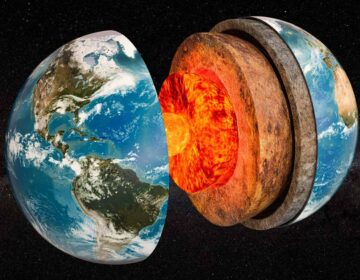
The surface of Earth has a measurable size. Scientists can calculate its total area, and if the planet were expanding, we would see its dimensions steadily increase over time.
Because Earth is something we can directly study, it also offers a helpful analogy for thinking about what might exist beyond the limits of the observable universe.
What lies beyond the cosmic horizon
Astronomers generally assume that the universe continues beyond the boundary we can observe. In other words, if our telescopes could see farther, we would likely find additional galaxies, stars, and cosmic structures stretching outward. The idea is similar to standing on Earth and looking toward the horizon. We cannot see the entire planet at once, yet we know more of it lies beyond the distance visible to our eyes.
This leads to a deeper question: how large is the universe as a whole, including the regions beyond what we can detect? In reality, scientists may never know the full answer. The observable universe represents a hard boundary for information. It limits not only what we can see, but also what knowledge can ever reach us. The universe contains a finite amount of information that could potentially arrive within our region of space, even if we waited indefinitely into the future.
All we can do is guess.
It’s totally possible that the universe is infinite. It just goes and goes and goes without end, forever.
But it’s also possible that it’s finite. But how can a finite universe still not have an edge? Well, how can the surface of the Earth be finite and yet not have an edge?
Curvature allows finite without edges
Yes, it has an edge in the third dimension – we call it outer space. But again, that’s cheating! The two-dimensional surface is both finite and borderless, and it accomplishes that seemingly paradoxical feat by being curved.
We know the surface of the Earth is curved. We can measure it without our feet ever leaving the ground. In mathematics, we can build a few tools to give us a clue as to the geometry of the Earth. One tool is triangles. On a perfectly flat plane, when you draw a triangle, the interior angles add up to 180 degrees. Thank you, Euclid. But if you were to bust out a giant marker, pick three random cities, and draw giant lines connecting them, you would end up with a triangle with interior angles greater than 180 degrees.