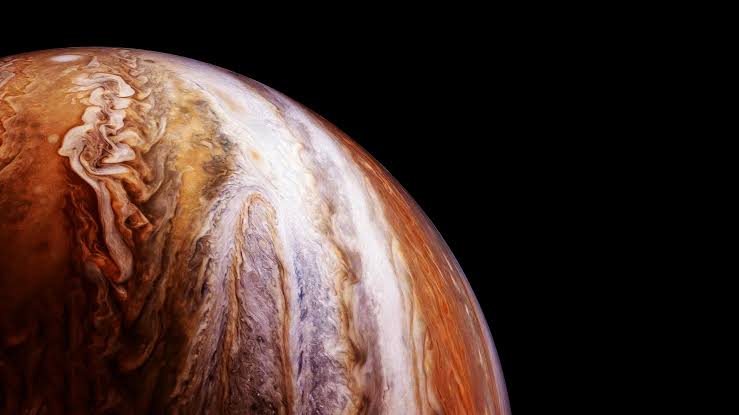
A distant Jupiter-like planet has revealed an unexpected secret: water-ice clouds hiding in its atmosphere. The discovery, made with JWST, shows these alien worlds are more complex than scientists thought.
Astronomers have identified an unexpected feature on a distant gas giant: water ice clouds. The finding comes from a team led by Elisabeth Matthews at the Max Planck Institute for Astronomy , and it highlights a major gap in how scientists model exoplanet atmospheres. The planet, Epsilon Indi Ab, is similar to Jupiter, yet its atmosphere appears more complex than predicted. The observing approach used in this study also represents an important step toward the long-term goal of detecting and studying Earth-like planets.
The Search for Life Beyond Our Solar System
One of the biggest goals in astronomy is to eventually detect signs of life on planets orbiting other stars. Researchers hope this could happen within the next few decades. Progress toward that goal has come in stages. From 1995 to about 2022, scientists focused mainly on discovering exoplanets using indirect techniques. These methods revealed key properties such as mass and size, and sometimes both.
The launch of the James Webb Space Telescope in 2022 marked the start of a new phase. Astronomers can now study the atmospheres of many exoplanets in detail, gaining insights into their composition and structure. Even so, this level of analysis is still a step away from directly searching for life, which will likely require future, more advanced telescopes.
The new study explores some of these more advanced techniques, though not yet for Earth-like planets. Elisabeth Matthews (Max Planck Institute for Astronomy), the study’s lead author, explains: “JWST is finally allowing us to study solar-system analog planets in detail. If we were aliens, several light-years away, and looking back at the Sun, JWST is the first telescope that would allow us to study Jupiter in detail. For studying Earth in detail, we would need much more advanced telescopes, though.”