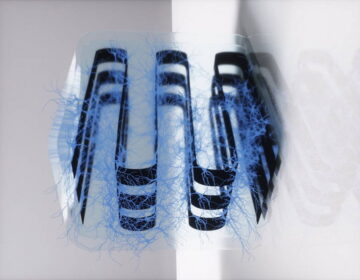

A 3D network of living neurons and electronics can recognize electrical patterns and may help researchers study both brain function and low-energy computing.
Princeton researchers have built a 3D device that brings living brain cells and advanced electronics together in one system. The device can be programmed with computational methods to recognize patterns.
Earlier efforts to use brain cells for computation have typically depended on flat 2D cell cultures grown in petri dishes or 3D cell clusters that are monitored and stimulated from the outside. The Princeton system is different because it is designed to interact with the cells from within the network.
The team used advanced fabrication methods to build a 3D mesh of microscopic metal wires and electrodes, held together by a very thin epoxy coating. That coating is flexible enough to work with the soft neurons that grow around it. The researchers used the mesh as a scaffold, allowing tens of thousands of neurons to grow into a large 3D network capable of computation.
A living network learns patterns
The researchers said this integrated design allowed them to record and stimulate neuronal electrical activity with much finer detail than earlier systems. Over more than six months, they monitored how the network changed, tested ways to strengthen or weaken connections between important neurons, and eventually trained an algorithm to identify patterns in electrical pulses.
In one experiment, the system was tested with pairs of different spatial patterns. In another, it was tested with different temporal patterns. In both cases, the system correctly told the patterns apart. The researchers said they aim to expand the platform so it can eventually handle more complex tasks.