Astronomers have understood for many decades that the universe is expanding. To calculate how quickly it is stretching today, researchers measure a value called the Hubble constant. Different techniques are used to determine this number, and because they rely on the same underlying physical laws, they should agree. Instead, measurements based on observations of the early universe do not match those based on the more recent universe. This discrepancy is known as the Hubble tension, and it remains one of the most important unanswered questions in cosmology.
A team of astrophysicists and cosmologists from The Grainger College of Engineering at the University of Illinois Urbana-Champaign and the University of Chicago has now introduced a new way to estimate the Hubble constant using gravitational waves, which are tiny ripples in spacetime.
Their approach improves the precision of earlier gravitational wave techniques. As detectors become more sensitive in the coming years, this strategy could lead to even tighter measurements and help clarify the source of the Hubble tension.
Illinois Physics Professor Nicolás Yunes said, “This result is very significant—it’s important to obtain an independent measurement of the Hubble constant to resolve the current Hubble tension. Our method is an innovative way to enhance the accuracy of Hubble constant inferences using gravitational waves.” Yunes is the founding director of the Illinois Center for Advanced Studies of the Universe (ICASU) on the Urbana campus.
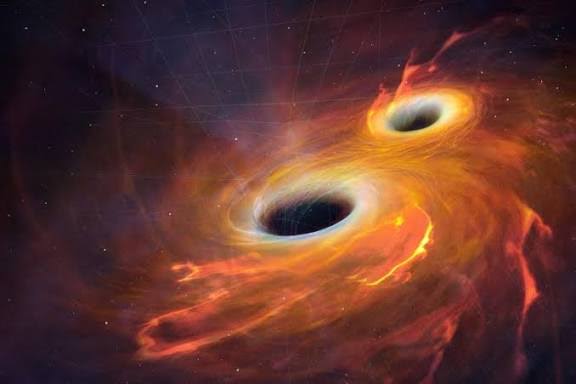
Daniel Holz, UChicago Professor of Physics and of Astronomy & Astrophysics and a co-author of the study, added, “It’s not every day that you come up with an entirely new tool for cosmology. We show that by using the background gravitational-wave hum from merging black holes in distant galaxies, we can learn about the age and composition of the universe. This is an exciting and completely new direction, and we look forward to applying our methods to future datasets to help constrain the Hubble constant, as well as other key cosmological quantities.”