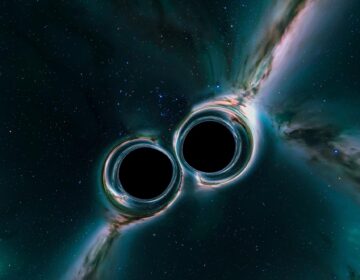
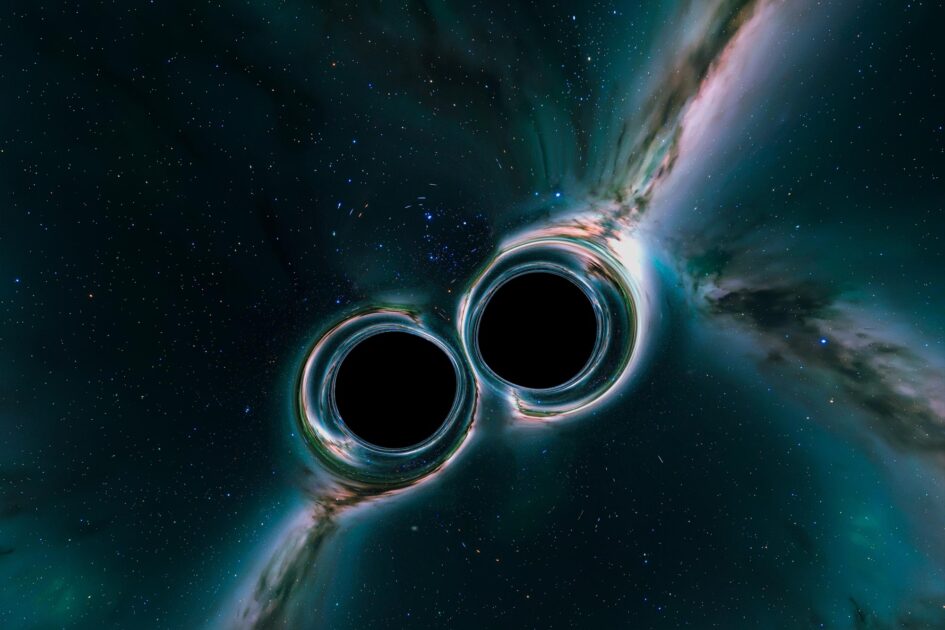
Scientists have developed a new technique that could turn black hole collisions into cosmic detectors for dark matter, revealing faint traces hidden inside gravitational waves.
Dark matter is believed to account for most of the matter in the universe, yet it appears to interact with ordinary matter only through gravity. Scientists think that if two black holes collide while moving through a dense region filled with dark matter, the resulting gravitational waves could contain subtle traces of that invisible material.
Researchers now believe those traces may be detectable in gravitational waves measured on Earth.
A team from MIT and several European institutions developed a method to predict how gravitational waves would differ if merging black holes traveled through dark matter instead of empty space. They tested the approach using publicly available data collected by LIGO-Virgo-KAGRA (LVK), the international network of observatories that detects gravitational waves from black hole mergers and other distant cosmic events.
The researchers analyzed signals recorded during LVK’s first three observing runs. Among the 28 clearest events, 27 matched expectations for black holes merging in a vacuum. One signal, known as GW190728, appeared to show possible evidence of a dark matter effect.
The team stresses that this is not a detection of dark matter. Instead, the method offers a new way to search gravitational-wave data for potential signs that can later be tested with additional studies.
“We know that dark matter is around us. It just has to be dense enough for us to see its effects,” says Josu Aurrekoetxea, a postdoc in the MIT Department of Physics. “Black holes provide a mechanism to enhance this density, which we can now search for by analyzing the gravitational waves emitted when they merge.”