By reading the chemical “fingerprints” of a distant galaxy, astronomers reconstructed its 12-billion-year evolution. This new method could reveal how galaxies including our own , were built over cosmic time.
A team of astronomers led by the Center for Astrophysics | Harvard and Smithsonian has, for the first time, applied galactic archaeology to uncover the history of a galaxy beyond the Milky Way. This approach studies the chemical signatures left behind in space to piece together how galaxies form and evolve.
The findings, published today in Nature Astronomy, introduce a powerful new method for reconstructing the life stories of distant galaxies. The work also helps establish a new research area known as “extragalactic archaeology.”
“This is the first time that a chemical archaeology method has been used with such fine detail outside our own galaxy,” says Lisa Kewley, lead author, Harvard professor, and director of the Center for Astrophysics. “We want to understand how we got here. How did our own Milky Way form, and how did we end up breathing the oxygen that we’re breathing right now?”
Mapping a Galaxy Using Chemical Fingerprints
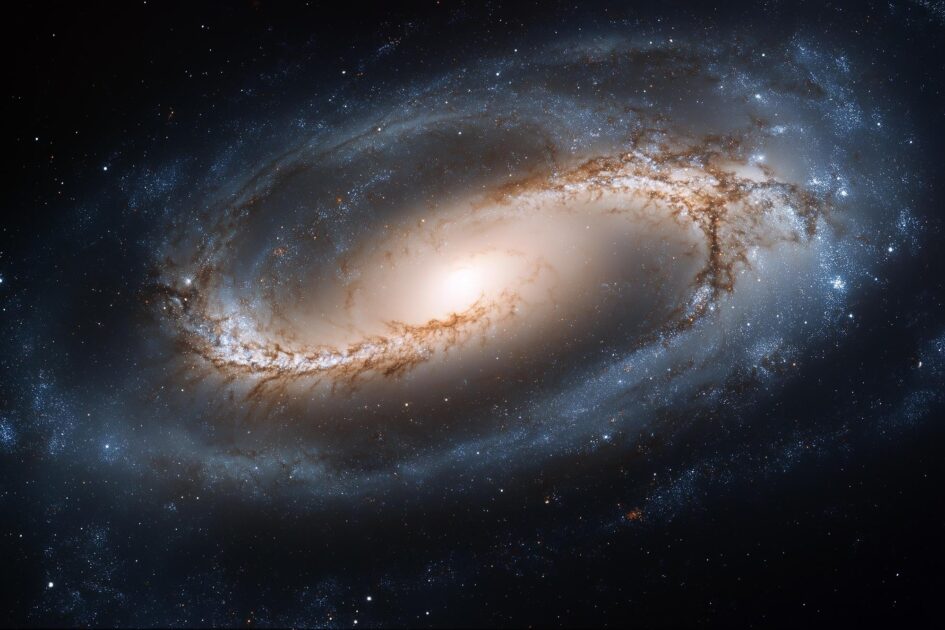
To carry out the study, researchers used data from the TYPHOON survey, collected with the Irénée du Pont telescope at Las Campanas Observatory. They focused on NGC 1365, a nearby spiral galaxy that appears face-on from Earth, making it easier to observe in detail. This allowed the team to isolate and analyze individual regions where new stars are forming.
Young, hot stars emit strong ultraviolet light, which energizes nearby gas. According to Kewley, this process causes elements such as oxygen to produce distinct, narrow lines of light. By studying these patterns, scientists can determine how elements are distributed across the galaxy.
Astronomers have long known that galaxy centers tend to contain higher concentrations of heavy elements like oxygen, while outer regions have less. These patterns are shaped by several processes, including when and where stars form and explode as supernovae, how gas moves in and out of the galaxy, and past interactions with other galaxies.