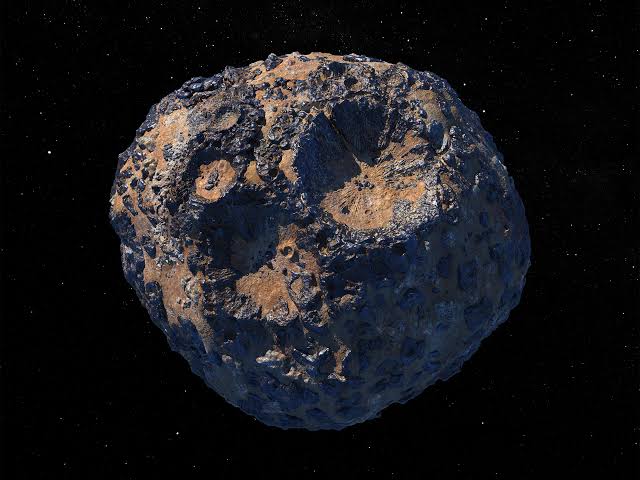
A massive crater on asteroid Psyche may hold the key to whether it’s a lost planet’s core or something more complex. New simulations suggest NASA’s upcoming mission could finally solve the mystery.
More than 200 years after asteroid 16 Psyche was first identified, scientists are still trying to understand how it formed.
Psyche is the 10th-most massive object in the main asteroid belt between Mars and Jupiter and the largest known metal-rich asteroid, measuring about 140 miles across. NASA’s Psyche mission is set to arrive in 2029 to investigate its origin. Researchers think it could be a remnant of an early planet that was torn apart by massive impacts, or a fragment of a once-layered body that lost its rocky outer layer.
Other theories suggest Psyche may have started out rich in metal, or became a mixture of rock and metal after repeated collisions with other asteroids. Each possibility points to a different explanation for how planets formed in the early Solar System.
Crater Simulations Offer Clues to Psyche’s Interior
To explore these ideas, scientists at the University of Arizona’s Lunar and Planetary Laboratory ran simulations to study how a large crater near Psyche’s north pole may have formed under different scenarios. Their study, published in JGR Planets, provides predictions that will help researchers interpret data from NASA’s Psyche mission once it arrives. When combined with spacecraft observations, these results could finally reveal what Psyche is made of.
“Large impact basins or craters excavate deep into the asteroid, which gives clues about what its interior is made of,” said Namya Baijal, a doctoral candidate at the LPL and first author of the paper. “By simulating the formation of one of its largest craters, we were able to make testable predictions for Psyche’s overall composition when the spacecraft arrives.”
Less than 10% of asteroids in the main belt are metal-rich, and Psyche is the largest of them. Still, scientists will need direct measurements from the spacecraft to determine how that metal is arranged inside.