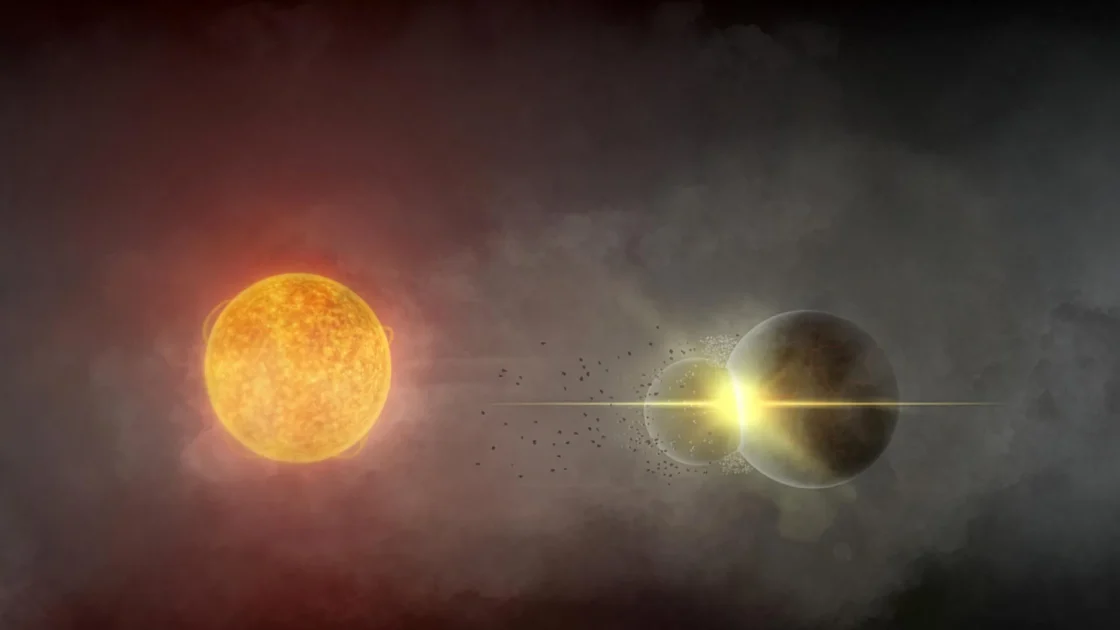
Astronomers have uncovered evidence of a dramatic cosmic crash unfolding around a distant star.While reviewing archived telescope observations from 2020, astronomer Anastasios (Andy) Tzanidakis noticed something unusual. A star that normally should behave in a predictable way was showing strange changes in brightness.
The star, called Gaia20ehk, lies about 11,000 light-years from Earth near the constellation Pupis. It is classified as a stable “main sequence” star similar to our sun, meaning its light should remain steady over time. Instead, the star began flickering dramatically.
“The star’s light output was nice and flat, but starting in 2016 it had these three dips in brightness. And then, right around 2021, it went completely bonkers,” said Tzanidakis, a doctoral candidate in astronomy at the University of Washington. “I can’t emphasize enough that stars like our sun don’t do that. So when we saw this one, we were like ‘Hello, what’s going on here?’”
Dust and Debris From a Planetary Collision
Scientists soon realized the strange flickering was not coming from the star itself. Instead, large amounts of rocky material and dust were moving across our line of sight as they orbited the star. This debris intermittently blocked some of the starlight traveling toward Earth.
The most likely explanation for such a massive cloud of debris is dramatic. Researchers believe two planets may have collided, sending fragments and dust into orbit around the star.
“It’s incredible that various telescopes caught this impact in real time,” Tzanidakis said. “There are only a few other planetary collisions of any kind on record, and none that bear so many similarities to the impact that created the Earth and moon. If we can observe more moments like this elsewhere in the galaxy, it will teach us lots about the formation of our world.”