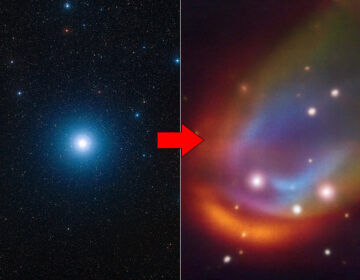
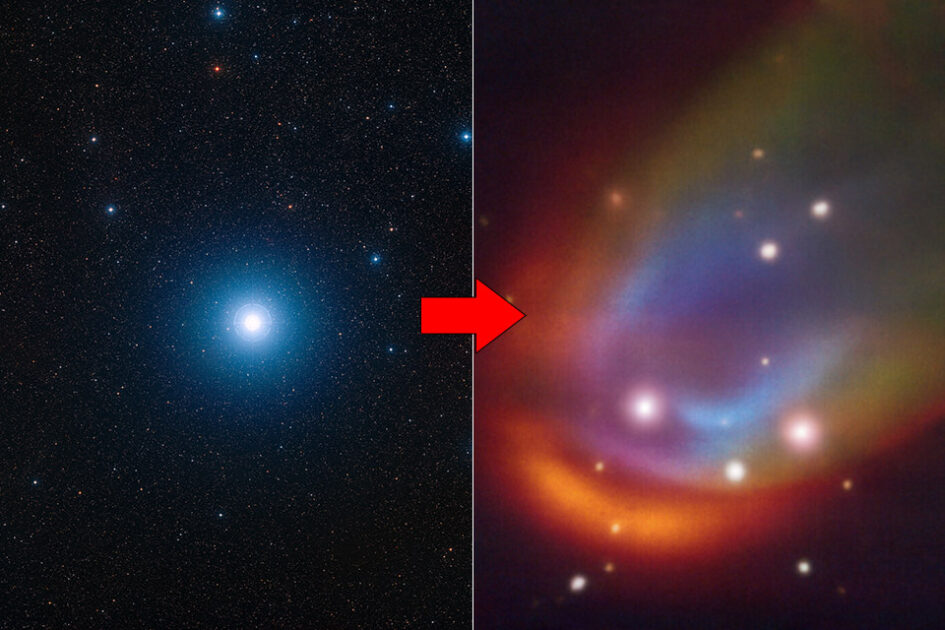
A mysterious bow shock around the white dwarf RXJ0528+2838 is challenging astronomers’ understanding of how dead stars interact with their surroundings.
Gas and dust streaming away from stars can sometimes collide with surrounding material and produce shock waves. Astronomers using the European Southern Observatory’s Very Large Telescope have now captured an especially striking example around a dead star. The discovery has left researchers puzzled because current theories cannot explain how such a structure formed.
The object, known as RXJ0528+2838, is a small dead star that should not produce a shock wave like the one observed. Yet images reveal a dramatic arc of glowing gas surrounding the system. The unexpected finding challenges existing ideas about how dead stars interact with the material around them.
“We found something never seen before and, more importantly, entirely unexpected,” says Simone Scaringi, associate professor at Durham University, UK and co-lead author of the study published in Nature Astronomy. “Our observations reveal a powerful outflow that, according to our current understanding, shouldn’t be there,” says Krystian Ilkiewicz, a postdoctoral researcher at the Nicolaus Copernicus Astronomical Center in Warsaw, Poland, and study co-lead. ‘Outflow’ is the term used by astronomers to describe the material that is ejected from celestial objects.
A Bow Shock in Interstellar Space
RXJ0528+2838 lies about 730 light-years (about 6.9 quadrillion kilometers or 4.3 quadrillion miles) from Earth. Like the Sun and other stars, it orbits the center of our galaxy. As the system moves through space, it interacts with the thin gas that fills the region between stars.