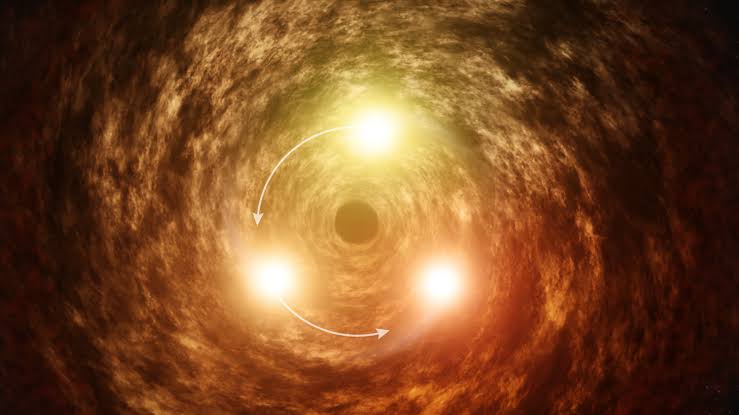
Powerful radiation from active supermassive black holes – believed to sit at the center of nearly every galaxy – may do more than disrupt their own surroundings. According to new research led by Yongda Zhu, a postdoctoral researcher at the University of Arizona Department of Astronomy and Steward Observatory, this energy can also suppress star formation in galaxies located millions of light years away.
“Traditionally, people have thought that because galaxies are so far apart, they evolve largely on their own,” said Zhu, the first author of the paper published in The Astrophysical Journal Letters. “But we found that a very active, supermassive black hole in one galaxy can affect other galaxies across millions of light-years, suggesting that galaxy evolution may be more of a group effort.”
Zhu describes this concept as a “galaxy ecosystem,” comparing it to connected ecosystems on Earth. “An active supermassive black hole is like a hungry predator dominating the ecosystem,” he said. “Simply put, it swallows up matter and influences how stars in nearby galaxies grow.”
Black holes have intrigued scientists and the public since they were first proposed in the early 1900s. These objects rank among the most extreme features of the universe. Their gravity is so intense that they can trap nearby material and even light. Some black holes, including the one at the center of the Milky Way, fall into the category of “supermassive,” meaning they contain millions or even billions of times the mass of our sun.
Although black holes themselves cannot be seen, they can become extraordinarily bright when actively feeding on surrounding gas and dust. As this material spirals inward, it forms a hot, rotating disk that releases vast amounts of energy. During this stage, known as a quasar phase, the black hole can radiate hundreds of trillions of times more energy than the sun, sometimes shining more brightly than its entire host galaxy.