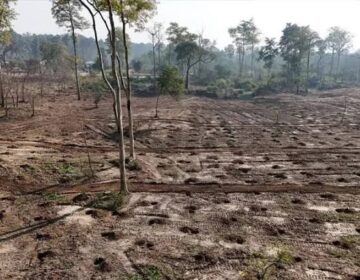
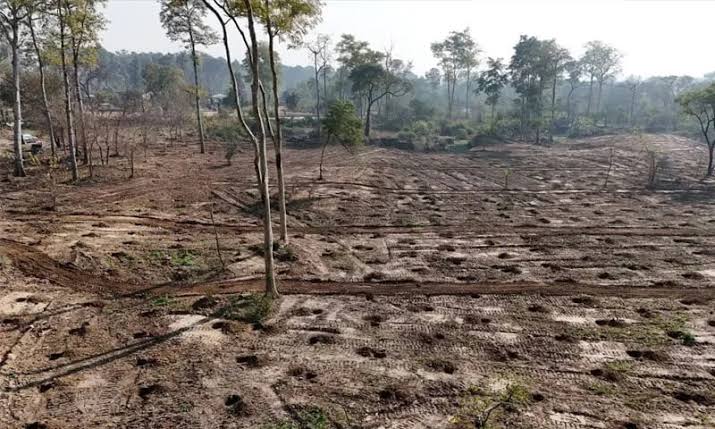
As authorities draw criticism over the large-scale cutting of trees in Islamabad, Minister of State for Health maintained pollen allergy cases in the federal capital had been on a decline following targeted felling.
He expressed these views during a meeting of the Senate Standing Committee on Climate Change, which was chaired by PPP Senator Sherry Rehman and focused on the management of paper mulberry trees and ecological restoration in Islamabad.
Recently, large-scale tree removal took place in at least three locations in Islamabad, including acres of tree cover around Shakarparian. Islamabad’s CDA has maintained that only paper mulberry trees were removed as they had been causing pollen allergies. WWF-Pakistan had also disputed Islamabad authorities’ stance, stating that the action was also linked to infrastructure development.
During the briefing the state minister shared the National Institute of Health’s data in connection with mitigating Islamabad’s severe seasonal pollen crisis.
According to Malik, cases of pollen allergy declined from over 2,300 in 2023 to 1,031 in 2025, while overall allergy prevalence in Islamabad fell from 45.8 per cent in 2023 to 33.3pc in 2025.
This, he said, indicated a reduced per capita risk of pollen allergy despite population growth.
Malik said that the invasive paper mulberry, the scientific name for which is broussonetia papyrifera, was a non-native species and was introduced in Islamabad between the 1960s and 1980s.