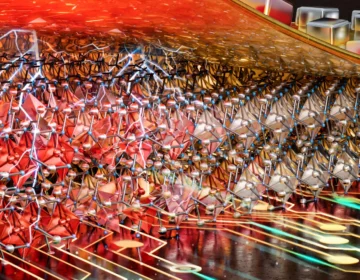

A new study shows that promising single-crystal battery materials degrade for reasons scientists hadn’t fully recognized before.
Scientists at Argonne National Laboratory and the UChicago Pritzker School of Molecular Engineering have identified the source of a long-standing problem in battery performance that has been linked to fading capacity, reduced lifespan, and, in rare cases, safety hazards such as fire.
Reporting their findings in Nature Nanotechnology, the research team describes how extremely small mechanical stresses can build up inside certain modern battery materials, eventually causing them to crack. The study also outlines practical approaches to reduce this damage in battery designs widely used for electric vehicles and other advanced technologies.
“Electrification of society needs everyone’s contribution,” said one of the corresponding authors Khalil Amine, Argonne Distinguished Fellow and Joint Professor at UChicago, “If people don’t trust batteries to be safe and long-lasting, they won’t choose to use them.”
Traditional lithium-ion batteries that rely on polycrystalline Ni-rich materials (PC-NMC) in their cathodes have long been known to suffer from cracking۔