
Scientists refine Earth’s rotation data and confirm rising solar activity after a prolonged quiet phase.
An international team combined historical geography with modern astronomical modeling to reassess what is considered the earliest precisely datable record of a total solar eclipse. By reconstructing how the Sun would have appeared from Qufu, the ancient capital of the Lu Duchy in China, the researchers were able to better estimate Earth’s changing rotation speed in 709 BCE.
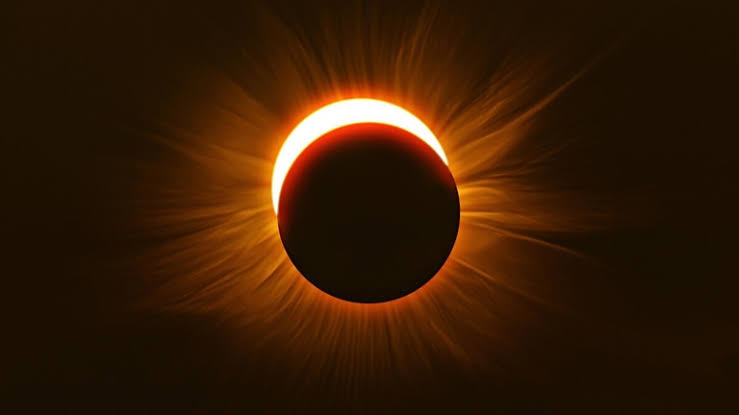
Using these reconstructions, the team also examined a historical description believed to refer to the solar corona, the Sun’s faint outer atmosphere that can be seen with the naked eye only during a total solar eclipse. The shape described in the ancient record appears consistent with modern reconstructions of solar activity in the 8th century BCE.
The 709 BCE Eclipse Record in Chinese Chronicles
Historical records indicate that the total solar eclipse took place on 17 July 709 BCE and was observed at the court of the Lu Duchy. The event was later documented in a historical text called the “Spring and Autumn Annals,” compiled roughly 2-3 centuries after the eclipse. The chronicle simply recorded that “the sun was totally eclipsed.”
“What makes this record special isn’t just its age, but also a later addendum in the ‘Hanshu’ (Book of Han) based on a quote written seven centuries after the eclipse.
It describes the eclipsed Sun as ‘completely yellow above and below.’ This addendum has been traditionally associated with a record of a solar corona. If this is truly the case, it represents one of the earliest surviving written descriptions of the solar corona,” lead author Hisashi Hayakawa, Assistant Professor from the Institute for Space-Earth Environmental Research and Institute for Advanced Research at Nagoya University, explained.
When the Scientists tested the record using modern eclipse calculations and models of Earth’s rotational history, the results initially suggested that a total eclipse would not have been visible from the Lu court in Qufu. This discrepancy led the team to suspect that earlier studies may have used incorrect coordinates for the ancient city.