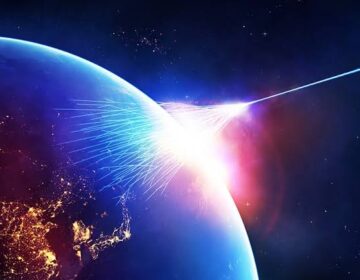

A new theoretical study explores how activity high above Earth could subtly influence processes deep within the planet’s crust.
Researchers at Kyoto University are advancing a new idea about how space weather might intersect with earthquake physics. Their model asks whether changes in the ionosphere could, in rare situations, apply additional electrical forces to already fragile parts of the Earth’s crust and help nudge a large quake toward initiation.
The work is not an earthquake forecasting method. Instead, it lays out a physical pathway that starts with solar flares and other intense solar activity, which can rapidly reshape the distribution of charged particles high above Earth. Those ionospheric charge shifts are measurable because they alter how satellite navigation signals travel through the upper atmosphere, a key reason scientists track total electron content in the first place.
Inside the crust, the model focuses on fractured rock zones that can trap water at extreme temperatures and pressures, potentially reaching a supercritical state. Under these conditions, the researchers treat the damaged region as electrically active, acting like a capacitor that is linked through capacitive coupling to both the ground surface and the lower ionosphere. In effect, the crust and the ionosphere become parts of one large electrostatic system rather than isolated layers.
Electrostatic Forces From Solar Activity
During strong solar events, electron density in the ionosphere can rise enough to form a more negative layer at lower altitudes. The model proposes that this atmospheric charge does not stay confined overhead. Because the system is capacitively connected, the changing ionospheric charge can translate into intensified electric fields within tiny voids in fractured crustal rock, on the scale of nanometers.