Halafian pottery shows that early agricultural societies practiced advanced mathematical thinking through plant-based art long before writing.
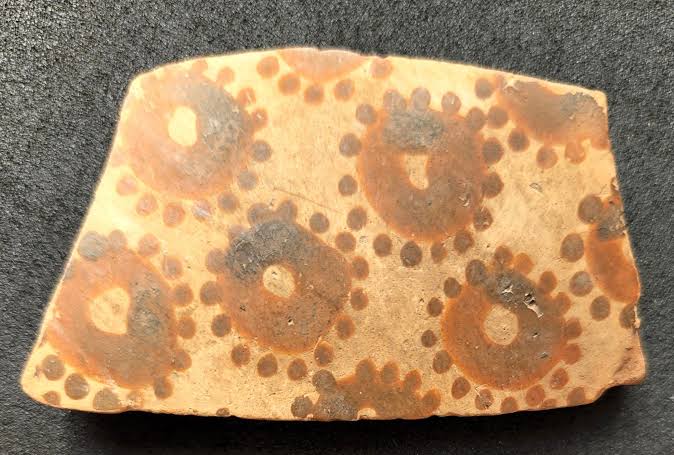
Researchers report that the Halafian culture of northern Mesopotamia (c. 6200–5500 BCE) created the earliest known systematic plant imagery in prehistoric art. Fine pottery from this period features flowers, shrubs, branches, and trees arranged with careful symmetry and repeating numerical patterns, most notably petal and flower counts of 4, 8, 16, 32, and 64.
These designs indicate that early farming communities in the Near East already used practical mathematical reasoning to divide space and quantities, likely connected to everyday tasks such as equitably sharing harvests from jointly cultivated land, long before writing or formal number systems appeared.
The findings come from a study published in the Journal of World Prehistory, which shows that some of the earliest artistic depictions of plants were not simply decorative but reflected underlying mathematical structure.
Through a detailed examination of ancient ceramics, Prof. Yosef Garfinkel and Sarah Krulwich of the Hebrew University identified the earliest consistent use of vegetal motifs in human history, dating back more than 8,000 years to the Halafian culture of northern Mesopotamia (c. 6200–5500 BCE). Their analysis reveals that these early agricultural societies painted flowers, shrubs, branches, and trees with deliberate precision, embedding evidence of advanced geometric and arithmetic thinking into their designs.