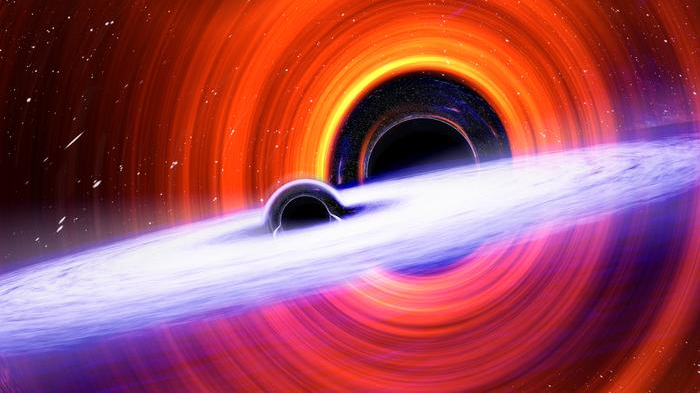
A detailed suite of simulations conducted by astrophysicists at the Flatiron Institute and their collaborators showed that magnetic fields can produce black holes with masses that were previously believed to be mostly unattainable.
In 2023, astronomers recorded a dramatic cosmic event. Two unusually large black holes collided about 7 billion light-years from Earth, and their immense size and rapid rotation immediately raised questions. Objects with these characteristics were not expected to form in the universe.
Researchers have now identified a possible explanation for how these black holes were created and eventually merged. Their detailed simulations, which track the entire evolution of the system from the birth of the parent stars to their final collapse, revealed a crucial factor that earlier studies had missed: the influence of magnetic fields.
“No one has considered these systems the way we did; previously, astronomers just took a shortcut and neglected the magnetic fields,” says Ore Gottlieb, astrophysicist at the CCA and lead author of the new study on the work published in The Astrophysical Journal Letters. “But once you consider magnetic fields, you can actually explain the origins of this unique event.”
The puzzling mass gap problem
The 2023 collision, now labeled GW231123, was detected by the LIGO-Virgo-KAGRA collaboration, which uses gravitational-wave observatories to measure slight disturbances in space-time caused by massive cosmic movements.
At first, scientists could not understand how such heavy and rapidly spinning black holes could have formed. Massive stars typically end their lives in explosive supernova events that can leave behind a black hole. However, stars within a certain mass range behave differently. They produce what is known as a pair-instability supernova, a powerful explosion that completely destroys the star and leaves no remnant.