
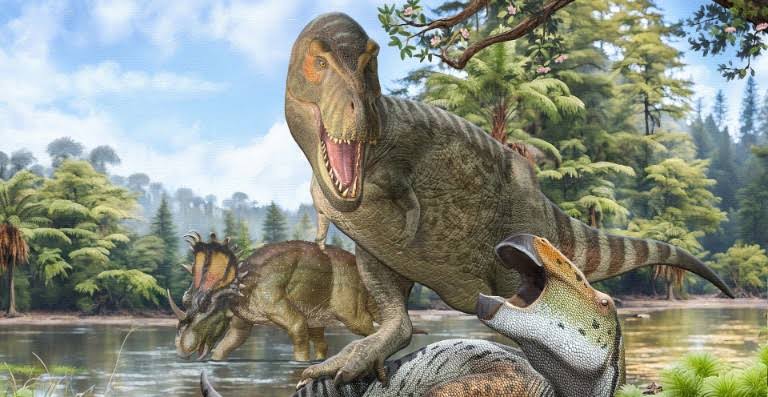
Research has overturned decades of uncertainty by showing that Nanotyrannus was a fully grown predator, not a juvenile T. rex.
Paleontologists have debated whether the single skull used to define the species Nanotyrannus belonged to a separate dinosaur or represented a young Tyrannosaurus rex. That question has now been resolved. A new study published in Science shows that Nanotyrannus was nearly fully mature and not a juvenile T. rex. The research also sheds light on how large tyrannosaurs grew so rapidly into massive apex predators.
A research team that included Dinosaur Institute Postdoctoral Fellow Dr. Zach Morris closely studied the Nanotyrannus holotype—the specimen used to establish the species—with particular attention to its throat bone. By analyzing microscopic details in this bone and comparing them with those of modern birds, crocodilians, and extinct dinosaurs—including the Dino Hall’s T. rex growth series—the team concluded that Nanotyrannus was a fully grown predator that occupied its own ecological niche. Although much smaller than an adult T. rex, it lived in a more diverse Late Cretaceous ecosystem than previously understood and likely competed with juvenile T. rex for prey.
“The identity of the holotype specimen was the key piece in this debate. Discovering that this small skull was actually fully grown shows definitively that it is different from Tyrannosaurus rex,” said Dr. Christopher Griffin, lead author and Assistant Professor of Geosciences at Princeton University.