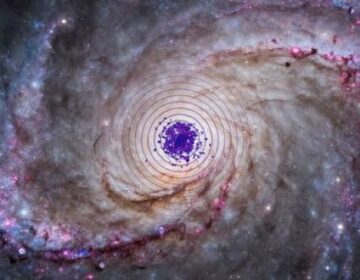
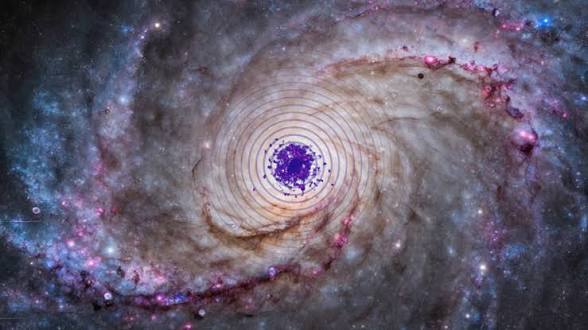
New research suggests our Sun was part of a huge migration of Sun-like stars that moved away from the Milky Way’s center billions of years ago.
Scientists have found new evidence that our Sun may have been part of a large-scale movement of similar stars that left the inner regions of the Milky Way about 4 to 6 billion years ago. Using data from the European Space Agency’s Gaia satellite, researchers built and analyzed an exceptionally detailed catalog of stars and their characteristics. Their results provide important clues about how our galaxy evolved, especially the formation of the rotating bar-shaped structure at its center.
Galactic Archaeology and the Sun’s Birthplace
On Earth, archaeology examines the past through artifacts and ruins. In space, a similar approach called galactic archaeology investigates the history of stars and galaxies. Scientists already know that the Sun formed around 4.6 billion years ago at a location more than 10,000 light-years closer to the center of the Milky Way than its current position.
The chemical composition of stars supports this idea, but it has puzzled astronomers for years. Observations of the Milky Way reveal a huge bar-like structure at the galactic center. This feature creates what scientists call a “corotation barrier,” a gravitational effect that makes it difficult for stars to travel far away from the central region.
A Massive Study of Solar Twins Using Gaia Data
To understand how the Sun could have reached its current location, a research team led by Assistant Professors Daisuke Taniguchi from Tokyo Metropolitan University and Takuji Tsujimoto from the National Astronomical Observatory of Japan conducted an unusually large investigation of solar “twins.” These stars closely resemble the Sun in temperature, surface gravity, and chemical composition.
The team relied on observations from the Gaia satellite mission, which has mapped roughly two billion stars and other celestial objects. From this enormous dataset, the researchers assembled a catalog of 6,594 solar twins. This sample is about 30 times larger than those used in earlier studies.