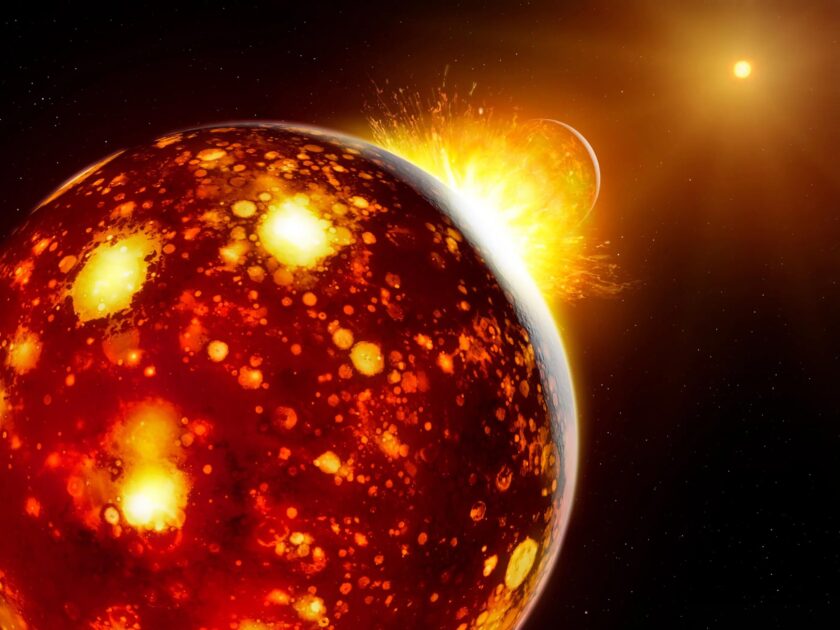
Around 4.5 billion years ago, an enormous protoplanet known as Theia struck the early Earth in what may have been the most influential event in our planet’s history. The precise sequence of the impact and the aftermath is still uncertain, but scientists agree on its consequences. The collision altered Earth’s size, structure, and orbital path, and it also led to the formation of the Moon, which has remained Earth’s constant partner ever since.
This raises several long-standing scientific questions. What kind of world was Theia before the crash? How large was it, what materials did it contain, and from which part of the Solar System did it originate? Although Theia itself was completely destroyed, its chemical fingerprints live on in both Earth and the Moon.
A new study published on November 20, 2025, in Science by researchers from the Max Planck Institute for Solar System Research (MPS) and the University of Chicago uses these remaining clues to reconstruct Theia’s likely composition and identify where it was formed.
The distribution of metal isotopes within a planetary body can reveal a great deal about its past. Isotopes are forms of an element that differ only in the number of neutrons in the atomic nucleus – and therefore in their mass. In the early Solar System, isotopes of the same element were not spread evenly. Materials that formed far from the Sun often developed slightly different isotope ratios compared with those that formed closer in. Because of this, the isotopic signature preserved in a body’s rocks contains information about where its building blocks originally came from.