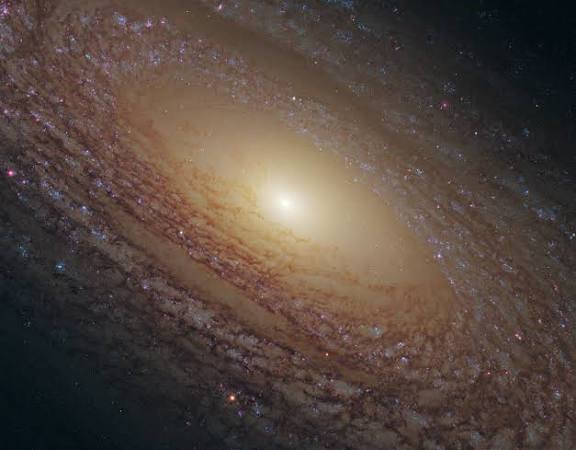
Hubble unveils the “Lost Galaxy” as a vibrant spiral alive with newborn stars and glowing clouds of cosmic energy.
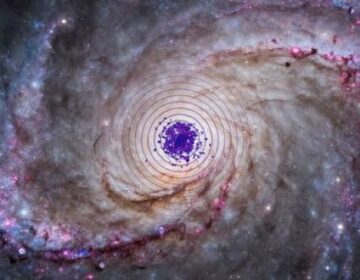
This Hubble Space Telescope image highlights the spiral galaxy NGC 4535, a vast system of stars located about 50 million light-years from Earth in the constellation Virgo (The Maiden).
While that distance is far beyond anything in our own galaxy, it places NGC 4535 in what astronomers consider the nearby universe. NGC 4535 has earned the nickname the ‘Lost Galaxy’ because it appears extremely faint when viewed through small backyard telescopes, making it difficult to study from the ground.
NASA’s Hubble Space Telescope is uniquely suited for observing galaxies like this one. Its primary mirror measures 2.4 meters across, allowing it to collect far more light than smaller instruments. This capability lets Hubble detect dim objects and reveal fine details, including the galaxy’s sweeping spiral arms and its central bar, a dense, elongated region packed with stars that helps shape the galaxy’s structure.
Young Star Clusters and Glowing Gas Clouds
One of the most striking features in this image is the abundance of young star clusters scattered along NGC 4535’s spiral arms. Star clusters are groups of stars that formed together from the same cloud of gas and dust. Many of these clusters shine with a bright blue color, which indicates that their stars are very hot and relatively young.
Surrounding many of these blue stars are glowing pink clouds known as H II (‘H-two’) regions. These clouds are made of hydrogen gas that has been energized by intense radiation from nearby massive stars. When this radiation heats the gas, it causes the clouds to glow, making them visible across vast distances. The presence of H II regions signals active star formation, meaning new stars are still being born within the galaxy.