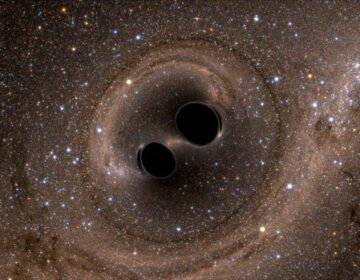
A new study proposes an innovative way to uncover elusive supermassive black hole binaries by tracking subtle, repeating flashes of starlight.
Researchers from Oxford University and the Max Planck Institute for Gravitational Physics (Albert Einstein Institute) have outlined a new way to uncover one of the universe’s most elusive phenomena: tightly bound pairs of supermassive black holes. These systems are expected to form after galaxies collide, yet astronomers have only confirmed widely separated pairs so far. The closest binaries, which are far more difficult to detect, may now be within reach.
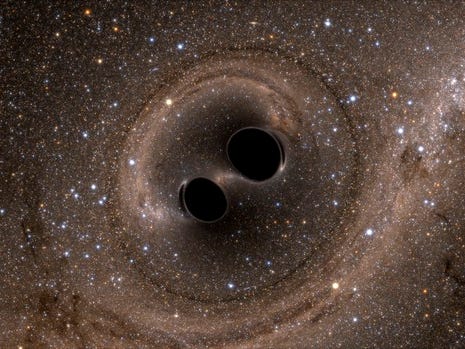
In a study published in Physical Review Letters, the team proposes tracking subtle, repeating flashes of light from stars positioned behind these hidden pairs. As the two black holes orbit each other, their immense gravity bends and briefly intensifies the starlight. The result is a series of bright, recurring signals that could reveal the presence of an otherwise invisible system.
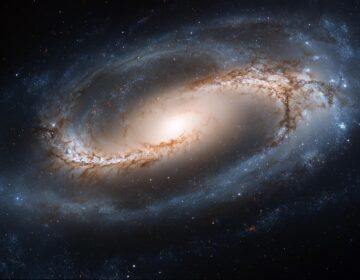
Supermassive black holes sit at the centers of most galaxies and can contain millions or even billions of times the mass of the Sun. When galaxies merge, their central black holes sink toward each other and eventually form a binary system. These pairs are not just cosmic curiosities. They are key players in shaping galaxies and are expected to generate powerful gravitational waves, ripples in spacetime that future space missions aim to detect directly.
What makes this new method especially promising is that it relies on light, not gravitational waves. That means astronomers may be able to identify these systems years before next-generation detectors come online. It also opens the possibility of studying them in much greater detail by combining different types of observations.
Gravitational Lensing as a Detection Tool
“Supermassive black holes act as natural telescopes,” said Dr. Miguel Zumalacárregui from the Max Planck Institute for Gravitational Physics. “Because of their enormous mass and compact size, they strongly bend passing light. Starlight from the same host galaxy can be focused into extraordinarily bright images, a phenomenon known as gravitational lensing.”