Astronomers have seen spacetime itself wobble near a spinning black hole for the first time. The discovery, revealed during a star’s destruction, confirms a major prediction of Einstein’s theory of relativity.
The universe has delivered a rare breakthrough for scientists who have been hunting one of the most difficult effects to observe in the cosmos.
In research published in Science Advances, astronomers report the first direct detection of a swirling distortion in spacetime produced by a fast-spinning black hole.
First direct view of black hole frame dragging
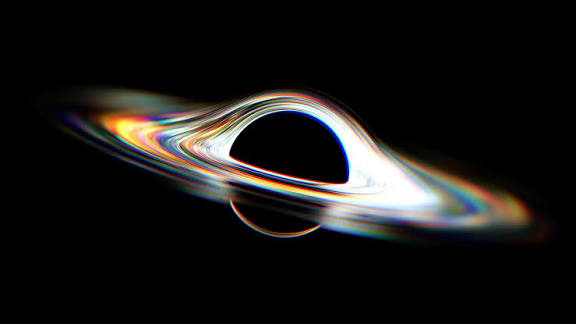
The phenomenon is called Lense-Thirring precession, also known as frame-dragging. It describes how a rotating black hole twists the spacetime around it, pulling nearby matter along and causing the paths of stars and gas to slowly wobble.
The research team was led by the National Astronomical Observatories at the Chinese Academy of Sciences, with support from Cardiff University. They focused on an object known as AT2020afhd, a tidal disruption event (TDE) in which a star was destroyed after wandering too close to a supermassive black hole.
A star torn apart reveals a spinning disk and jets
As the star was ripped apart, its debris settled into a rapidly rotating disk around the black hole. At the same time, powerful jets of material were launched outward at close to the speed of light.
By studying repeating patterns in X-ray and radio signals from this event, the scientists found that both the disk and the jet were wobbling together. This coordinated motion repeated every 20 days, providing a clear signature of the spacetime twisting effect.