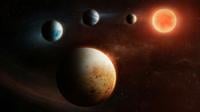
Scientists have identified a rocky outer planet in a system where a gas giant was expected. The discovery challenges traditional models and supports the idea that planets may form one by one in changing environments.
When scientists survey planetary systems across the Milky Way, they tend to see a familiar arrangement. Small, rocky worlds circle close to their parent star, while large gas giants orbit much farther out. Our Solar System fits this pattern perfectly. The inner planets: Mercury, Venus, Earth, and Mars, are made mainly of rock and metal. Beyond them lie Jupiter, Saturn, Uranus, and Neptune, which are dominated by thick gaseous envelopes.
This layout is explained by a widely accepted model of planet formation. Young stars emit powerful radiation that can strip lightweight gases from nearby developing planets, leaving dense, rocky cores behind. At greater distances, cooler temperatures allow planets to retain thick atmospheres, enabling them to grow into gas giants.
A Rule-Breaking System Around LHS 1903
A newly studied system orbiting the star LHS 1903 does not follow this expected structure. The results were published in Science.
LHS 1903 is a red dwarf, smaller and dimmer than our Sun. Researchers led by Prof. Ryan Cloutier of McMaster University and Prof. Thomas Wilson of the University of Warwick combined observations from telescopes on Earth and in space to analyze the system. They initially identified three planets. Closest to the star is a rocky world, followed by two gas-rich planets similar to scaled-down versions of Neptune. That arrangement aligns with standard theories.