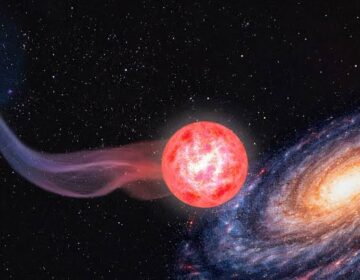
Astronomers have uncovered an extraordinarily ancient star that offers a rare glimpse into the universe’s earliest chapters.
An international team of astronomers has identified the most chemically pristine star ever observed, named SDSS J0715-7334, using data from the Sloan Digital Sky Survey-V (SDSS-V) along with follow-up observations from the Magellan telescopes at Carnegie Science’s Las Campanas Observatory in Chile. The discovery is detailed in Nature Astronomy.
The research was led by University of Chicago astronomer Alexander Ji, a former Carnegie Observatories postdoctoral fellow, and included Carnegie astrophysicist Juna Kollmeier, who oversees the fifth generation of SDSS. The team determined that this star belongs to only the second generation of stars formed in the universe, emerging a few billion years after the Big Bang.
“These pristine stars are windows into the dawn of stars and galaxies in the universe,” Ji explained. Several of his and Kollmeier’s co-authors on the paper are undergraduate students from UChicago, whom Ji brought to Las Campanas on an observing trip for spring break last year. “My first visit to LCO is where I really fell in love with astronomy, and it was special to share such a formative experience with my students.”
From the Big Bang to the First Stars
The universe began as an extremely hot and dense mixture of particles following the Big Bang. As it expanded, it cooled, allowing neutral hydrogen gas to form. Over hundreds of millions of years, regions with slightly higher density collapsed under their own gravity, giving rise to the first stars, composed almost entirely of hydrogen and helium.
These early stars burned intensely and had short lifespans. Before they died, they created heavier elements through nuclear fusion and then scattered those materials into space through powerful explosions. Later generations of stars formed from this enriched material, gradually increasing the variety of elements found throughout the universe.
Why Metal-Poor Stars Matter
“All of the heavier elements in the universe, which astronomers call metals, were produced by stellar processes—from fusion reactions occurring within stars to supernovae explosions to collisions between very dense stars,” said Ji. “So, finding a star with very little metal content in it told this group of students that they’d come across something very special.”