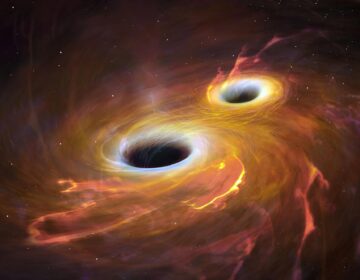
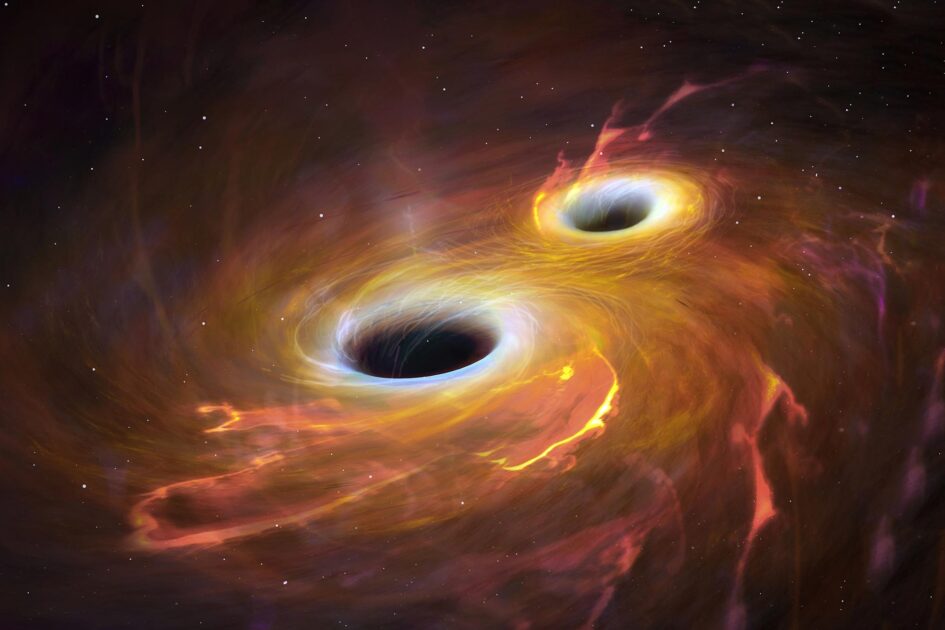
Researchers discovered a closely orbiting pair of supermassive black holes in Markarian 501 by tracking two jets of particles. The binary system could merge within 100 years and may produce detectable gravitational waves.
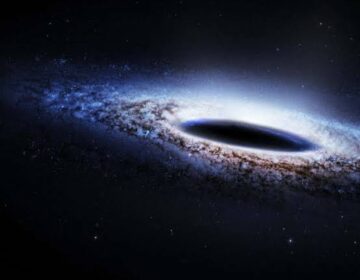
Current evidence indicates that nearly every large galaxy contains a supermassive black hole at its center, with a mass ranging from millions to billions of times that of the Sun. Exactly how these objects grow so large remains a major unanswered question. Accumulating (accreting) gas from their surroundings alone would be too slow, suggesting that mergers with other massive black holes play a crucial role in their growth.
Galaxy collisions are common throughout the Universe, making it likely that the supermassive black holes at their centers also eventually merge. Before combining into a single object, the two black holes are expected to orbit one another while gradually moving closer together.
Yet scientists have struggled to model the final stages of this process accurately. Despite the frequency of galaxy mergers over cosmic timescales, no close pair of supermassive black holes had been definitively identified. A new study of the galaxy Markarian 501 (Mrk 501) in the constellation Hercules has now provided compelling evidence.
An international team led by Silke Britzen of the Max Planck Institute for Radio Astronomy (MPIfR) in Bonn discovered direct signs of a supermassive black hole pair at the center of Mrk 501. The findings have been published in the Monthly Notices of the Royal Astronomical Society.
Twin Jets Reveal a Hidden Black Hole Pair
The supermassive black hole at the center of Mrk 501 produces a powerful jet of particles that travels through space at nearly the speed of light. To investigate the region, researchers examined high-resolution observations spanning multiple radio frequencies. The data were collected over approximately 23 years across dozens of observing sessions. Instead of finding only one jet, the team identified a second jet as well.