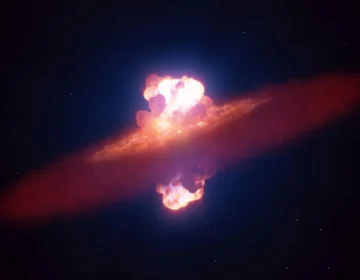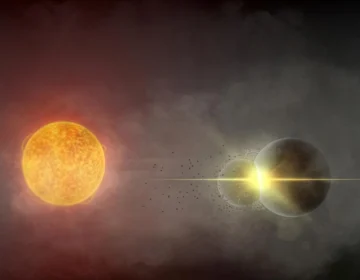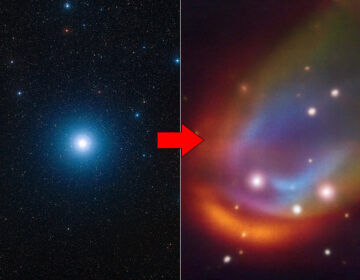
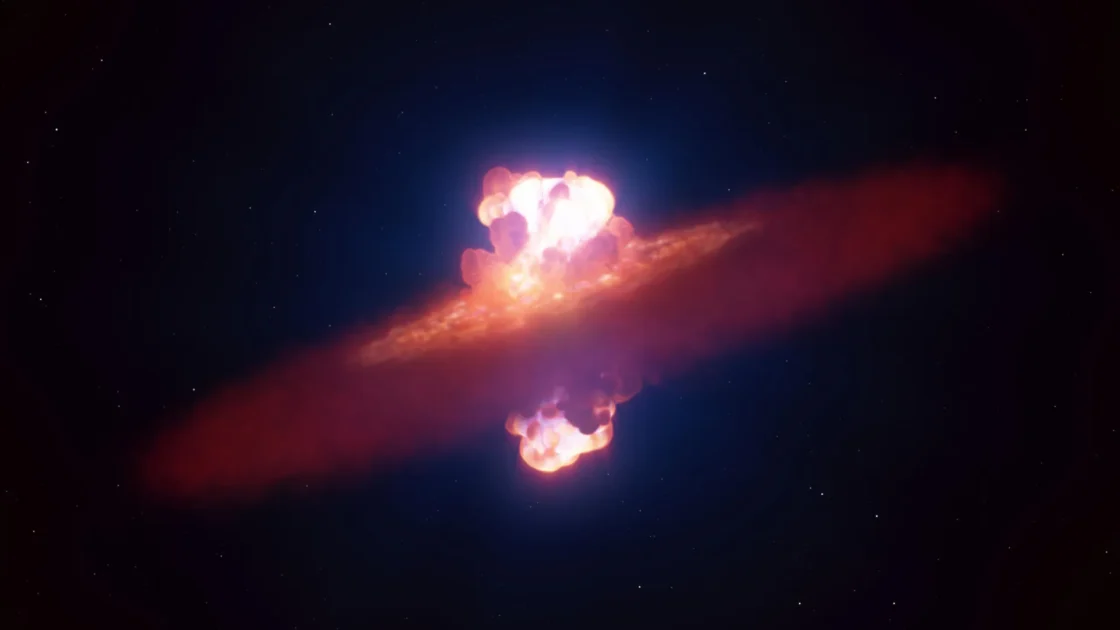
Astronomers have identified the first clear evidence of a magnetar forming during a superluminous supernova, offering new insight into some of the brightest explosions in the universe.
Astronomers have observed the birth of a magnetar for the first time and confirmed that this extreme object powers some of the brightest stellar explosions in the universe. A magnetar is a rapidly spinning neutron star with an extraordinarily strong magnetic field.
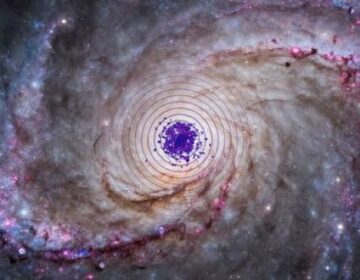
The discovery supports a theory first proposed by a UC Berkeley physicist 16 years ago. It also identifies a new behavior in exploding stars. Some supernovae display a “chirp” pattern in their light curves that arises from effects predicted by general relativity. A study describing this phenomenon was published in the journal Nature.
Superluminous supernovae can shine 10 times brighter or more than typical stellar explosions. Since their discovery in the early 2000s, these events have puzzled astronomers. Scientists suspected they came from the deaths of extremely massive stars, possibly around 25 times the mass of our sun. However, their brightness persists much longer than expected after a star’s iron core collapses and the outer layers are blasted into space.
The Magnetar-Powered Supernova Theory
In 2010, Dan Kasen, now a theoretical astrophysicist and physics professor at UC Berkeley, proposed that a newly formed magnetar could drive this extended glow. His idea, developed with Lars Bildsten and independently suggested by Stanford Woosley of UC Santa Cruz, describes what happens when a massive star reaches the end of its life.
During the collapse, much of the star’s material compresses into an extremely dense neutron star. This outcome is just short of forming a black hole. If the original star possessed a powerful magnetic field, the collapse could amplify it dramatically during magnetar formation. The result would be a magnetic field between 100 and 1,000 times stronger than those found in ordinary spinning neutron stars known as pulsars. Both pulsars and magnetars are only about 10 miles across, yet young ones can rotate more than 1,000 times per second.