A new RNA-based therapy aims to address one of cardiology’s most persistent challenges: the heart’s inability to regenerate after injury.
After a heart attack, restoring blood flow is often only part of the battle. Even when blocked arteries are reopened, the heart is left with permanent damage because lost muscle cells do not grow back.
“The heart is one of the organs with the least ability to regenerate,” said Ke Cheng, Alan L. Kaganov Professor of Biomedical Engineering at Columbia Engineering. “The spontaneous regeneration power is very, very limited.”
That limitation is a major reason many survivors later develop heart failure. Now, researchers are working on a different strategy, one that does not just prevent further damage but actively helps the heart repair itself.
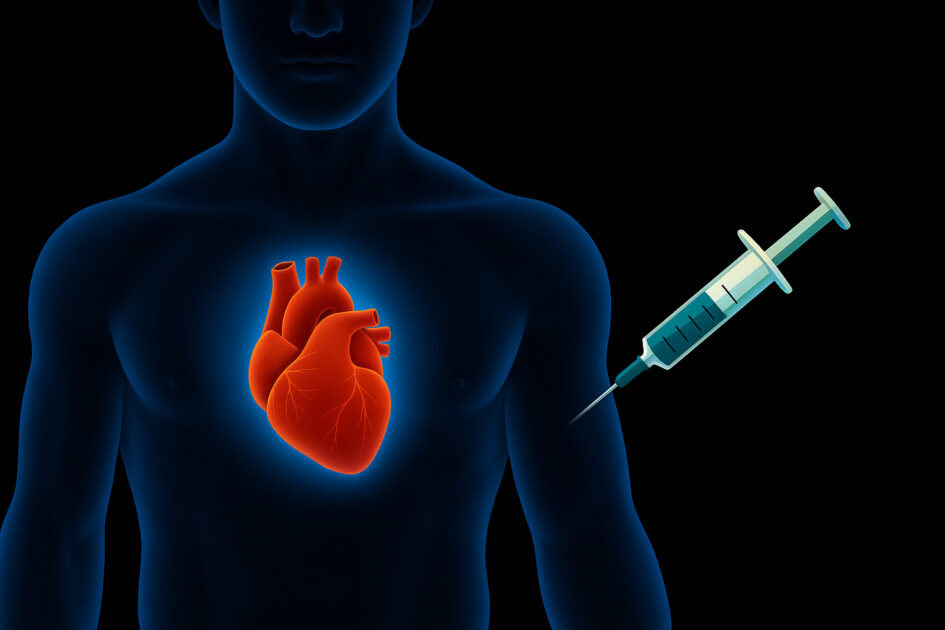
In a study published in Science, Cheng and his colleagues present an experimental therapy that turns the body into its own drug producer. Instead of delivering medicine directly to the heart, the approach uses RNA to instruct other tissues to generate a healing molecule that becomes active only once it reaches the heart.
“You don’t have to open the chest or send a wire to the heart to deliver this drug,” Cheng said. “In principle, all the clinician needs to do is to inject the particles into the arm.”
For cardiologists like study co-author Torsten Vahl, this shift could address a long-standing gap in care.
“As a clinician who opens up arteries with stents for patients who come to us with heart attacks, I am highly aware that we have a large unmet need for our patients,” Vahl said. “Too many times, they are left with severe heart damage that results later in heart failure.”