A potential new mineral on Mars forms when iron sulfates are heated above 100°C. Data from Valles Marineris regions suggest geothermal processes altered ancient sulfate deposits.
A study published in Nature Communications reports the discovery of an iron sulfate on Mars that may represent a previously unknown mineral. Sulfur is abundant on the planet and often combines with other elements to create sulfate minerals.
On Earth, most sulfates dissolve easily when exposed to rain. Mars, however, has an extremely dry surface. Because of this, sulfate minerals can remain stable for billions of years, preserving valuable evidence about the planet’s early conditions. Every mineral has its own crystal structure and physical properties, including well-known examples such as gypsum and hematite.
Researchers use measurements from spacecraft orbiting Mars to detect minerals on the planet’s surface and to reconstruct the environments where those minerals formed. For nearly two decades, scientists have been trying to explain unusual layered iron sulfates that show a distinctive spectral signal in orbital data.
Solving a 20-Year Mystery of Martian Iron Sulfates
A research team led by Dr. Janice Bishop, senior research scientist at the SETI Institute and NASA’s Ames Research Center in California’s Silicon Valley, combined laboratory experiments with satellite observations of Mars. Their work identified and described a rare ferric hydroxysulfate phase.
The findings provide new understanding of how heat, water, and chemical processes have shaped the Martian surface.
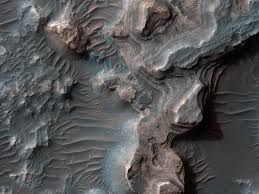
“We investigated two sulfate-bearing sites near the vast Valles Marineris canyon system that included mysterious spectral bands seen from orbital data, as well as layered sulfates and intriguing geology,” said Bishop.
The investigation focused on two locations. One was Aram Chaos, northeast of Valles Marineris, where ancient water once flowed toward lower northern regions. The other was the plateau above Juventae Chasma, a canyon about 5 kilometers deep located just north of Valles Marineris.