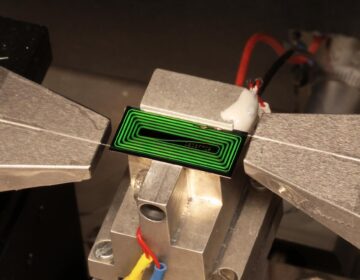
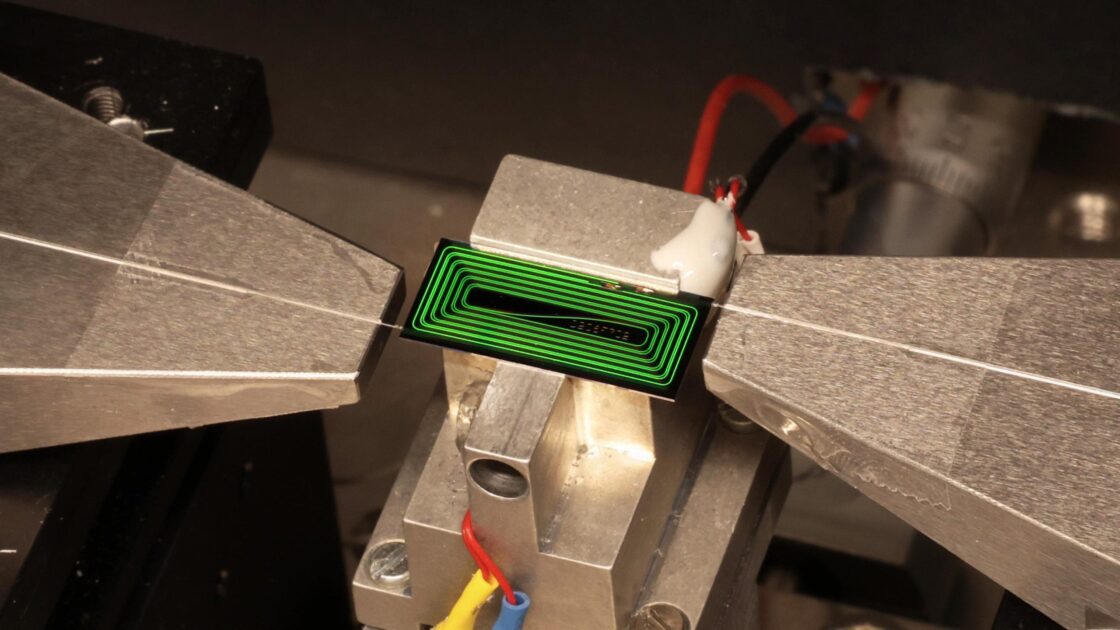
Scientists have finally packed a laboratory-class ultrafast laser onto a tiny photonic chip.
Ultrafast lasers generate bursts of light that last only a few hundred femtoseconds, each one just a quadrillionth of a second long. These extremely short pulses are used in a wide range of technologies, including precision manufacturing, eye surgery, and optical frequency combs, the Nobel Prize-winning innovation that powers the world’s most accurate optical atomic clocks.
Despite their importance, ultrafast lasers have generally remained large, costly systems that occupy entire optical tables in research laboratories. After more than two decades of work by scientists around the world, shrinking these devices onto a photonic chip has remained an elusive goal.
Now researchers led by Professor Tobias J. Kippenberg at EPFL have achieved that milestone. Writing in Nature, the team reports the first integrated ultrafast laser capable of matching the performance of traditional tabletop femtosecond lasers, producing pulses as short as 147 femtoseconds with energies reaching 1.05 nanojoules.
Bringing Ultrafast Lasers to Photonic Chips
Photonic chips manipulate light using microscopic structures called waveguides that are patterned onto a wafer. In many ways, they function like electronic chips, except they direct light rather than electrical currents. These chips are already widely used in telecommunications and have helped shrink many optical technologies that once required much larger equipment.
“For more than twenty years, a high-pulse-energy femtosecond laser on chip was widely regarded as a holy grail of integrated photonics,” says Kippenberg. “Our result shows that it is not only possible, but that it can be achieved with a surprisingly elegant architecture that the integrated-photonics community had overlooked.”