Einstein–Rosen bridges may reflect a two-directional structure of time that preserves information and hints at a pre–Big Bang universe.
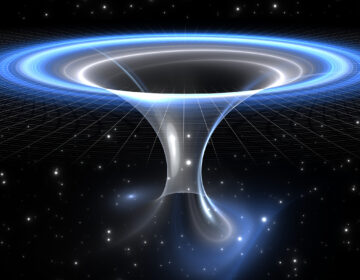
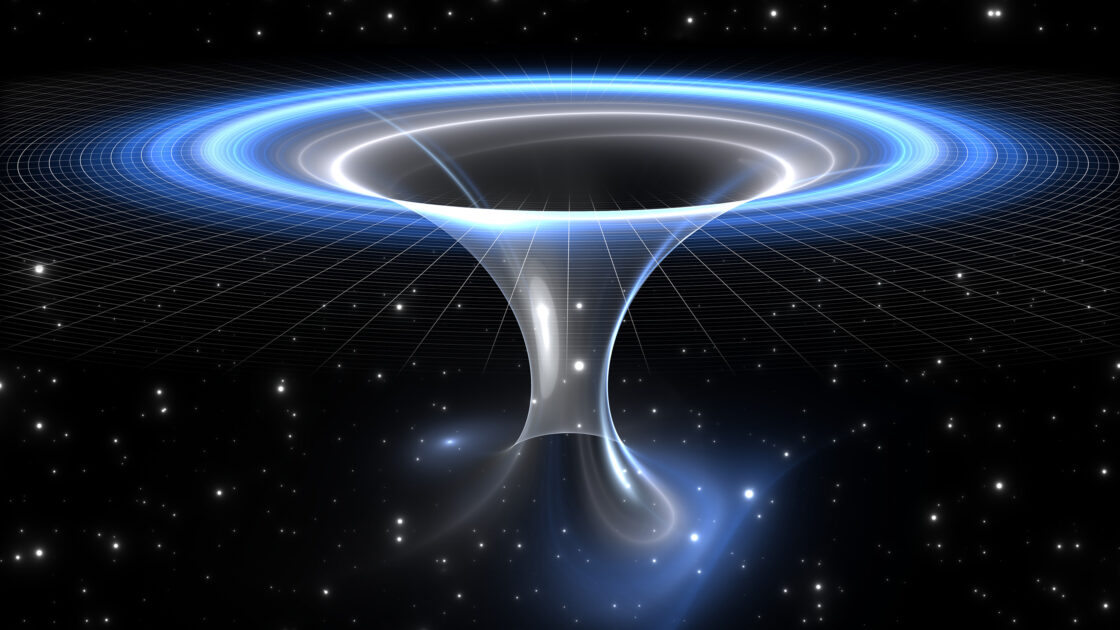
Wormholes are commonly portrayed as cosmic passageways that connect distant parts of space or even different moments in time. However, that popular image stems from a misunderstanding of earlier work by physicists Albert Einstein and Nathan Rosen.
In 1935, Einstein and Rosen were not trying to describe interstellar shortcuts. They were examining how particles behave under extreme gravitational conditions when they proposed what they called a “bridge.” This concept describes a mathematical connection between two identical, mirrorlike versions of spacetime.
Its purpose was to preserve consistency between general relativity and emerging ideas in quantum physics, not to create a route for travel. The association between Einstein–Rosen bridges and wormholes developed later, even though it diverged from the original intent.
In our recent research, my colleagues and I revisit this idea and argue that the Einstein–Rosen bridge suggests something much more fundamental than a hypothetical tunnel through space.
The puzzle Einstein and Rosen were addressing was never about space travel, but about how quantum fields behave in curved spacetime. Interpreted this way, the Einstein–Rosen bridge acts as a mirror in spacetime: a connection between two microscopic arrows of time.
Quantum mechanics governs nature at the smallest scales such as particles, while Einstein’s theory of general relativity applies to gravity and spacetime. Reconciling the two remains one of physics’ deepest challenges. And excitingly, our reinterpretation may offer a path to doing this.