Scientists confirmed that an exoplanet mirrors its star’s chemical makeup, validating a core assumption about how planets form and evolve.
Astronomers have found that the giant exoplanet WASP-189b closely matches the chemical makeup of its parent star, offering the first direct confirmation of a key idea in astrobiology.
The breakthrough came from the first simultaneous detection of gaseous magnesium and silicon in a planet’s atmosphere. Researchers made the observations using the Gemini South telescope, part of the International Gemini Observatory, which is partly funded by the U.S. National Science Foundation and operated by NSF NOIRLab.
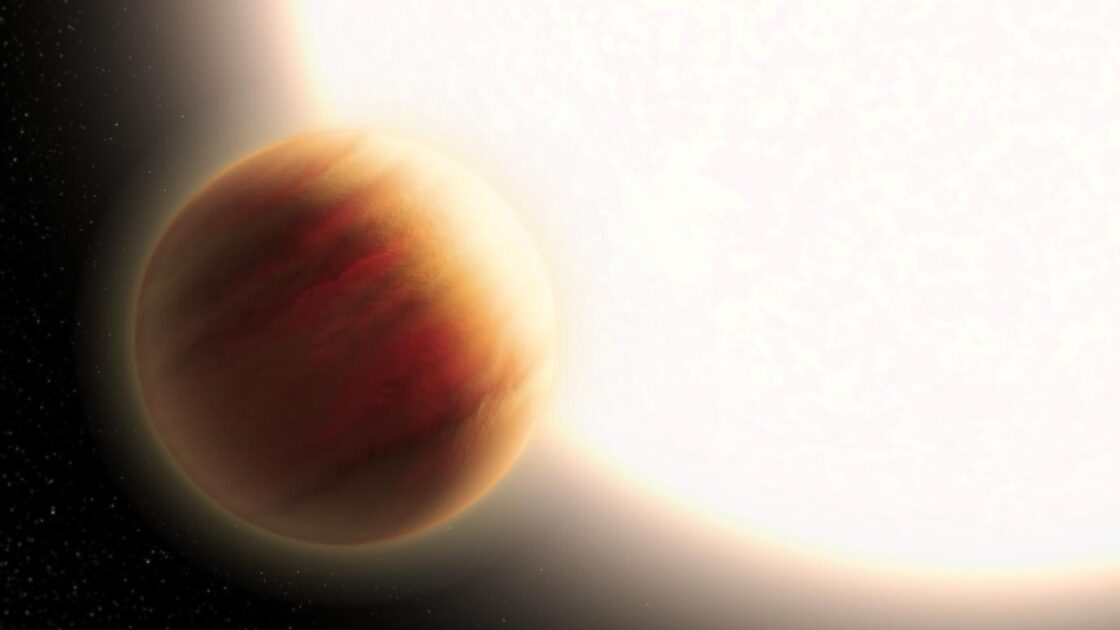
Located nearly 320 light-years (about 1.9 quadrillion miles) away in the Libra constellation, WASP-189b is classified as an ultra-hot Jupiter (UHJ). These planets reach temperatures high enough to vaporize rock-forming elements such as magnesium (Mg), silicon (Si), and iron (Fe). This makes them ideal targets for spectroscopy—a method that separates light into its component wavelengths to identify chemical signatures.
The study was led by Jorge Antonio Sanchez, a graduate student at Arizona State University (ASU), along with an international team of astronomers. They observed WASP-189b using the high-resolution Immersion GRating INfrared Spectrograph (IGRINS) mounted on the Gemini South telescope in Chile. This instrument enabled them to measure magnesium and silicon in the planet’s atmosphere at the same time.